

Well-designed internal packaging reliably protects products from knocks, vibrations and shifting – whether in a box, on a pallet or in a SLC container. Just like an airbag and seatbelt in a car, internal packaging absorbs shocks and impacts, keeping your product securely in place. It is key to transport safety, thereby reducing complaint rates and ensuring efficient logistics processes.

Padding, filling, fastening: the functions of inner packaging
Inner packaging serves many purposes. It cushions, secures and separates goods. Whether it’s paper padding, air cushions or film securing on a tray: the solutions and choice of materials for inner packaging are varied and depend primarily on the weight, impact sensitivity and surface of the packaged goods.
Padding and filling materials protect your goods from damage caused by knocks and crushing. With the right fastening, the packaged goods remain in place so that nothing shifts during transport. And dividing compartments and inserts prevent products from colliding with one another.
We would be happy to advise you and work with you to find the optimal inner packaging for your specific application. Naturally, we will also weigh up the pros and cons in terms of sustainability with you.
Air cushions and air cushion systems
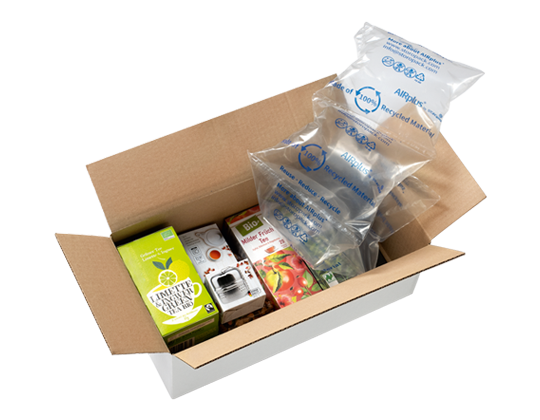
1% film, 99% air = 100% product protection. The padding volume of the air cushions is only generated at the packing station and therefore saves a lot of storage space. The lightweight air cushions, which can come in different designs, perfectly protect against shocks, impact or vibrations during transport. Your packaged goods remain elastically fixed in the package.
Example of air cushion systems
Filler paper – even for strong padding
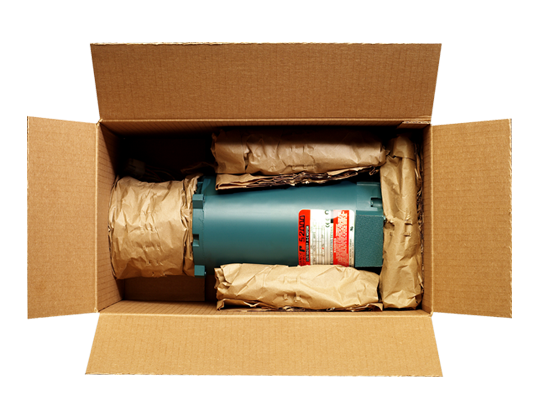
Paper has strength – and not just when it comes to kraft paper. When converted into filling material or padding, paper also keeps heavy components in place within the outer packaging and protects them from the rigours of transport. Paper converting packaging machines produce padding and fillings in various shapes, tailored to the specific application, directly at your packing station.
Our paper manufacturing department offers packaging paper in different thicknesses, available in sheets or rolls. We share a tradition with paper that stretches back more than 100 years.
Examples of paper converter systems
Fastening packaging
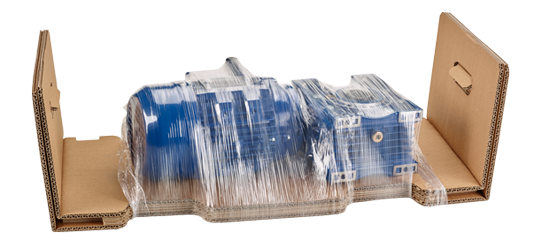
Fastening packaging secures non-fragile parts to a corrugated cardboard sheet by wrapping them in elastic film, regardless of their shape. They are transported safely in a suitable cardboard box. The same result can be achieved using two pre-assembled frames covered with elastic film, between which a part is held securely in place. With both methods, different parts can be securely packaged within the maximum limits.
Example of horizontal wrapper
Foam padding – when a precise fit is essential
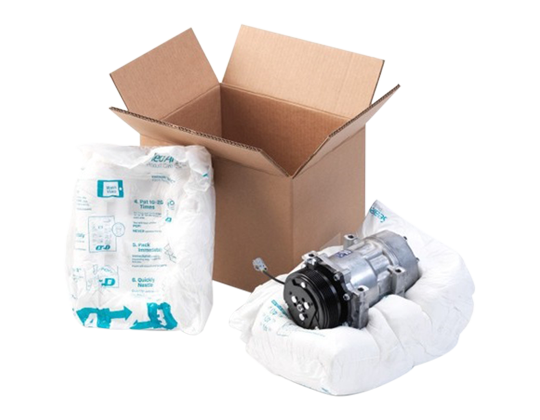
Foam cushions provide a perfect fit for sensitive, high-value products and effectively absorb shocks. They essentially mould themselves to the product’s shape – right at the packing station and without the need for any equipment or machinery.
Thanks to their flat packaging, foam cushions can be stored in a space-saving manner. Only after being activated by hand does the foam expand to 27 times its volume and mould itself perfectly to the shape of any product.
We would be happy to advise you on when a foam packaging system is the right solution for you.
Inner packaging with additional function
Corrosion protection, packaging density optimisation and more
With padding, filling and securing, standard inner packaging often does the job in many cases. However, it sometimes needs to fulfil additional functions.
Specialised packaging materials offer additional corrosion protection, protection against moisture, electrostatic discharge and much more when transporting sensitive goods.
A bespoke new development can also go beyond the standard. Structural packaging for special requirements – such as when shipping dangerous goods – often requires bespoke solutions. Even as the inner lining of outer packaging, for example in the form of optimised compartments, it protects products of every shape and nature: optimised for packing density, perfectly integrated into the packaging process and, above all, effective.

